Your AI agent buys the wrong thing. Who pays?
A CSA research note on ChatGPT Wallet: the Face ID tap that protects your card may also move the loss to you.
- dispute cases left unresolved
- 2
- network pledged to absorb (Amex)
- 1
- direct loss share for the AI lab
- 0
- claims checked
- 9
Your AI agent buys the wrong thing. You approved it with Face ID. Who pays?
A research note from @cloudsa, published Nov 15, works through exactly that for ChatGPT Wallet.
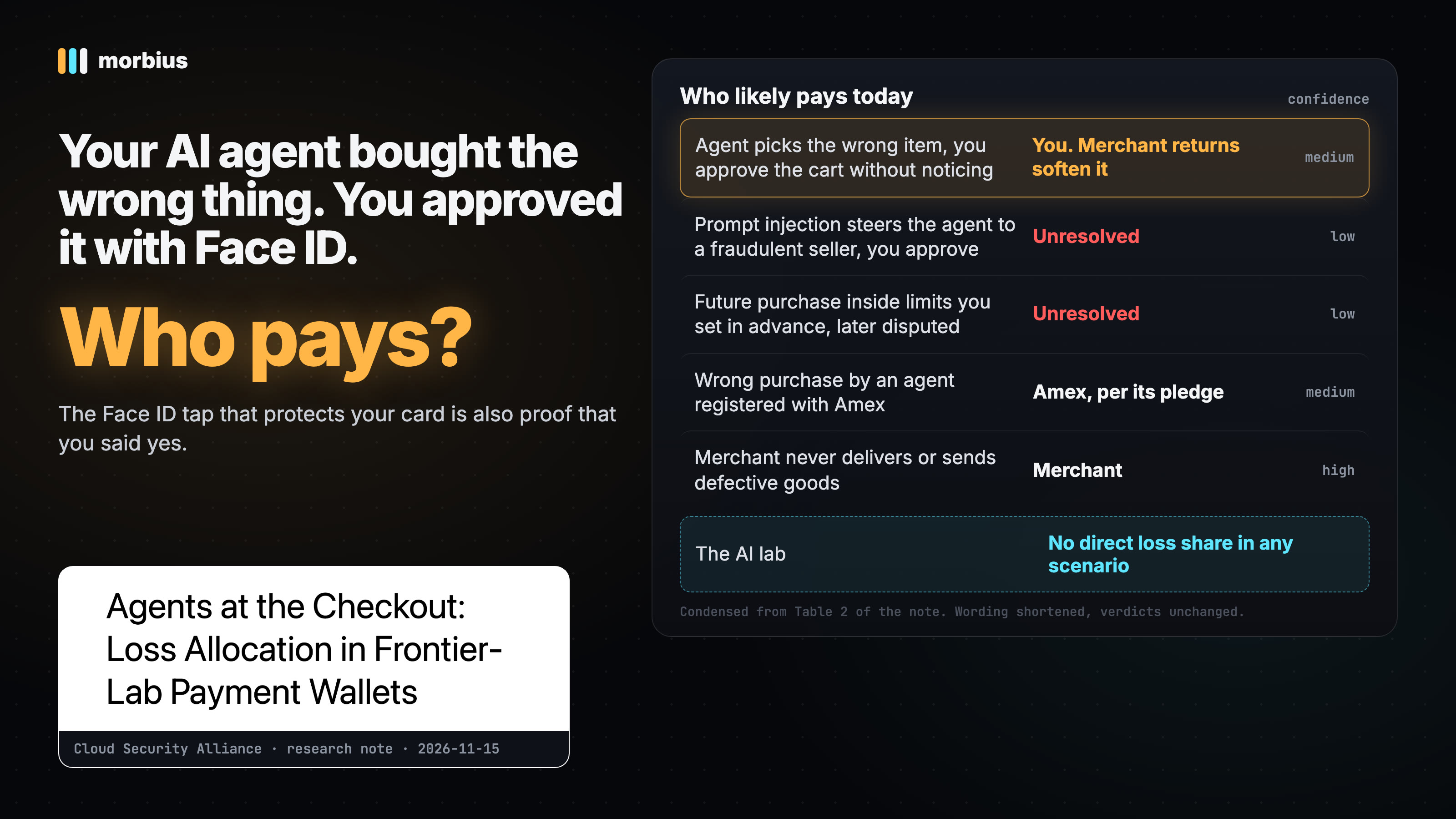
Their read: the Face ID tap that keeps your card safe is also strong proof that you authorized the purchase. So if the agent picks the wrong item and you approve without noticing, the loss likely moves toward you. Merchant returns are the cushion.
Other cases from their table:
→ Prompt injection steers the agent to a bad seller, you approve: unresolved
→ A purchase inside limits you set in advance, later disputed: unresolved
→ A wrong purchase by an agent registered with @AmericanExpress: Amex has pledged to absorb it
→ The AI lab itself: no direct loss share in any scenario
@OpenAI says you keep your card's dispute protections, for example when an item is defective. It doesn't say who pays when the agent buys the wrong thing and you signed off.
One line from the note stuck with us. The best evidence of what you actually asked for now sits with the agent platform, not with your bank or the store.
So in a dispute, the record of your instruction is held by the company whose agent made the call.
Would you let an agent shop for you before this gets settled?
Claim by claim
Main source: Cloud Security Alliance AI Safety Initiative, research note "Agents at the Checkout: Loss Allocation in Frontier-Lab Payment Wallets", published 2026-11-15 (labs.cloudsecurityalliance.org).
-
01
REAL (their analysis)
A per-purchase Face ID approval is strong evidence that you authorized the purchase
CSA note: per-purchase biometric approval "produces strong evidence that the cardholder authorized each transaction"
-
02
REAL (their analysis)
Wrong item, you approved without noticing: the loss likely moves to you, merchant returns soften it
CSA note, Table 2, confidence: medium
-
03
REAL (their analysis)
Prompt injection steers the agent to a bad seller and you approve: unresolved
Table 2, confidence: low
-
04
REAL (their analysis)
Purchase inside limits set in advance, later disputed: unresolved
Table 2, confidence: low
-
05
REAL (their analysis)
Wrong purchase by an agent registered with Amex: Amex has pledged to absorb it
Table 2, confidence: medium
-
06
REAL (their analysis)
The AI lab has no direct loss share in any scenario
Table 2 assigns the lab no direct share in any row
-
07
REAL
OpenAI says you keep your card's dispute protections, for example for defective items
openai.com/index/introducing-chatgpt-wallet (Nov 13): "Users keep their card's existing rewards and protections for eligible disputes with businesses, for example when an item is defective."
-
08
REAL
OpenAI does not say who pays when the agent buys the wrong thing and you approved it
Not addressed on the announcement page. The CSA note makes the same observation
-
09
REAL (their analysis, paraphrased)
The best evidence of what you asked for now sits with the agent platform
CSA note: the most probative evidence of user intent "now sits with the agent platform rather than with the issuer or the merchant"
"Their analysis" means the claim is the researchers' reading of current rules, not a court ruling.
Corrections
None so far.